
Python Program to Generate Random List and Find Position & Occurrences
📚 Table of Contents
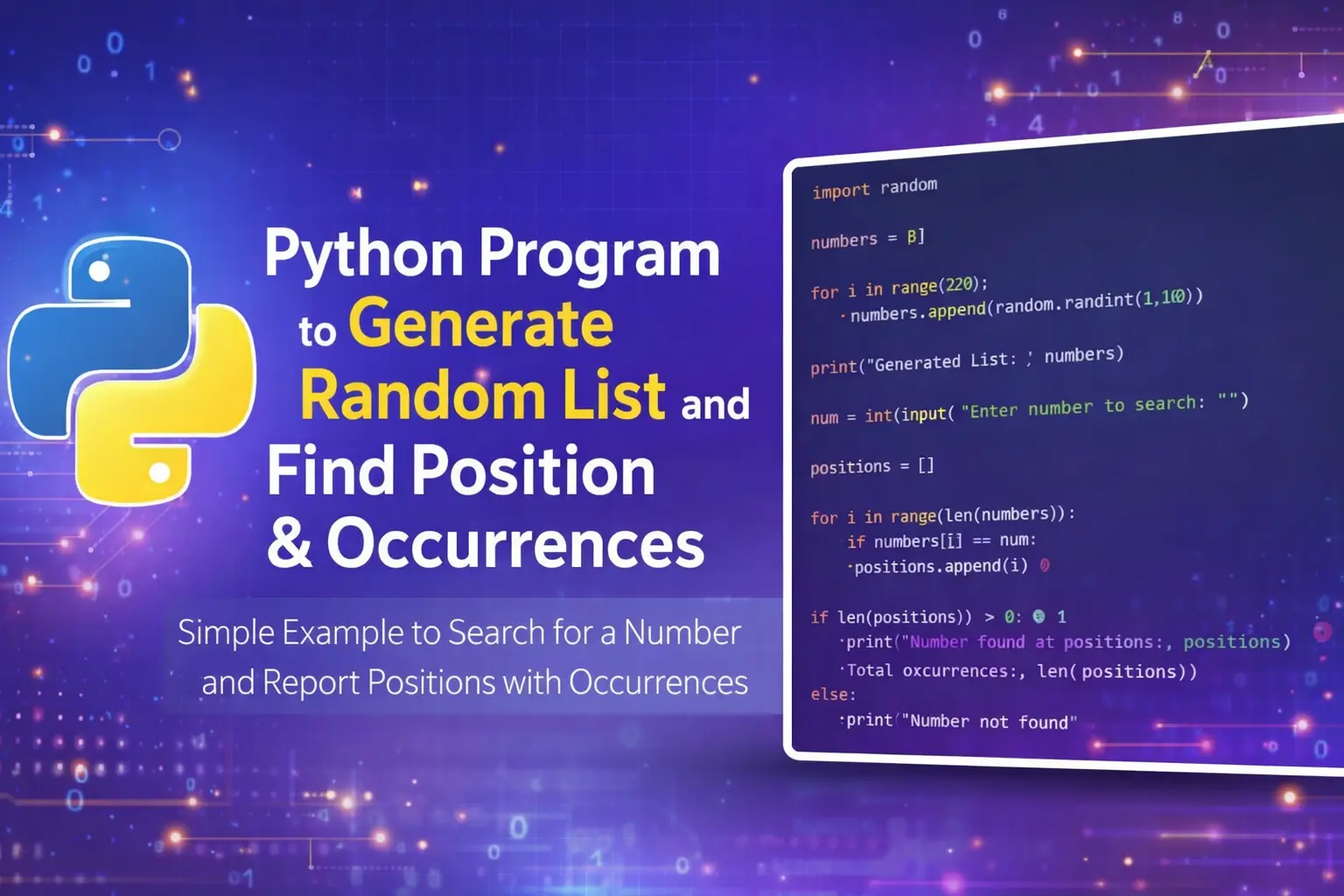
This Python program generates a list of 20 random numbers and allows the user to enter a number from the keyboard. The program then finds the positions where the number appears in the list and counts its total occurrences. This example helps beginners understand Python lists, loops, and searching techniques.
📌 Quick Summary
Python Program: Random List and Find Position & Occurrences Python list is one of the most commonly used data structures in programming. In this ex...
This article is written for beginners who want to learn and build a career in Python Program to Generate Random List and Find Position & Occurrences.
Python Program: Random List and Find Position & Occurrences
Python list is one of the most commonly used data structures in programming. In this example, we generate a list of 20 random numbers and search for a number entered by the user. The program then displays the positions and the number of occurrences.
Program Objective
- Generate 20 random numbers in a list
- Accept a number from the user
- Find the positions of that number in the list
- Count how many times it appears
Python Program
import random

numbers = []

for i in range(20):
    numbers.append(random.randint(1,10))

print("Generated List:", numbers)

num = int(input("Enter number to search: "))

positions = []

for i in range(len(numbers)):
    if numbers[i] == num:
        positions.append(i)

if len(positions) > 0:
    print("Number found at positions:", positions)
    print("Total occurrences:", len(positions))
else:
    print("Number not found")
Example Output
Generated List: [3,5,2,5,8,5,1,9,4,5,6,7,5,2,3,5,1,8,5,4]

Enter number to search: 5

Number found at positions: [1,3,5,9,12,15,18]
Total occurrences: 7
Explanation
The program first generates a list of random numbers using the random module. Then it takes input from the user and checks each element in the list using a loop. If the element matches the entered number, its position is stored. Finally, the program prints the positions and total occurrences.
Conclusion
This program is useful for beginners learning Python lists, loops, and searching techniques. It is commonly used in Python practical exams and programming practice.
🔗 Related Articles
https://www.kaishclasses.com/best-python-training-institute-lucknow.php👉 Want to start your career? Join KAiSH Computer Institute today.