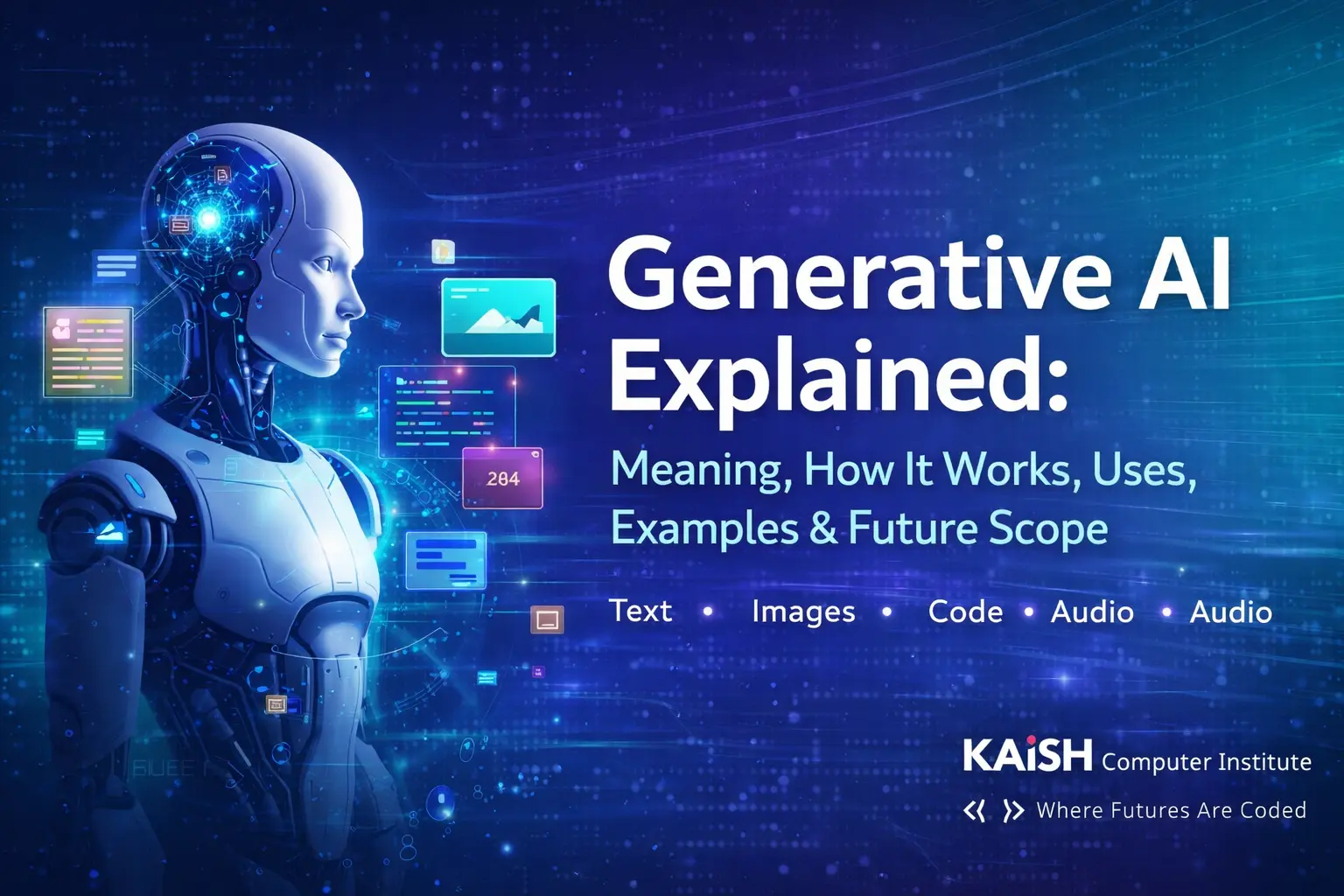
Generative AI Explained: Meaning, How It Works, Uses, Examples & Future Scope
📚 Table of Contents
Generative AI is a modern form of Artificial Intelligence that creates text, images, code, and more. Learn how it works, its uses, examples, and future scope.
📌 Quick Summary
What is Generative AI? Generative AI is an advanced and fast-growing branch of Artificial Intelligence that focuses on creating new, original, and...
This article is written for beginners who want to learn and build a career in Generative AI Explained: Meaning, How It Works, Uses, Examples & Future Scope.
What is Generative AI?
Generative AI is an advanced and fast-growing branch of Artificial Intelligence that focuses on creating new, original, and meaningful content such as text, images, audio, videos, presentations, marketing creatives, and even computer programs.
Unlike traditional AI systems that are mainly designed to analyze, classify, or predict outcomes from existing data, Generative AI goes one step ahead. It learns deep patterns from massive datasets and then generates fresh outputs that closely resemble human creativity and intelligence.
Today, Generative AI is being actively used by students, professionals, startups, and large IT companies across the world. In India, especially in emerging tech hubs like Lucknow, Generative AI skills are becoming extremely valuable for careers in software development, digital marketing, data science, automation, and AI-driven business solutions.
How Generative AI Works
Generative AI works using advanced machine learning and deep learning techniques, particularly Large Language Models (LLMs), transformer-based architectures, and neural networks. These models are trained on enormous volumes of structured and unstructured data, including text, images, videos, audio, and source code.
During the training phase, the AI system learns relationships, probabilities, grammar, context, and patterns hidden within the data. Once trained, it can respond intelligently to user prompts and generate content that feels natural, relevant, and human-like.
- Data Collection: High-quality datasets are collected from diverse and reliable sources
- Training Phase: Neural networks learn structure, meaning, and context
- Inference: The trained model generates responses based on user input
- Continuous Learning: Performance improves through updates and feedback
Popular Generative AI Models and Tools
Several Generative AI tools and platforms are widely adopted across education, IT, marketing, and research sectors:
- ChatGPT – Conversational AI, content writing, coding assistance
- Google Gemini – Multimodal AI for text, images, logic, and reasoning
- DALL·E – AI-powered image and design generation
- Midjourney – Creative and artistic AI visuals
- Stable Diffusion – Open-source image generation technology
Real-Life Examples of Generative AI
- AI chatbots handling customer queries 24×7
- AI-generated blog posts, articles, reports, and emails
- Automatic code generation, debugging, and documentation
- AI-created posters, banners, ads, and social media creatives
- Voice assistants and AI-generated audio narration
Uses of Generative AI
Generative AI is transforming multiple industries by improving efficiency, creativity, and decision-making:
- Education: Smart learning, notes generation, doubt-solving assistance
- Content Creation: Blogs, ads, SEO content, videos, presentations
- Software Development: Faster coding, testing, and deployment
- Healthcare: Medical research analysis and report summarization
- Customer Support: AI-powered chatbots and voice assistants
Application Areas of Generative AI
- Digital Marketing & SEO Automation
- Media, Entertainment & Content Studios
- Banking, Finance & FinTech Solutions
- IT and Software Development Industry
- Education & Training Institutes
In Lucknow, students and working professionals are increasingly learning Generative AI to stay competitive in the modern IT job market and prepare for future technology-driven roles.
Advantages of Generative AI
- Significantly reduces manual work and time consumption
- Boosts productivity and operational efficiency
- Encourages innovation and creative problem-solving
- Automates repetitive and routine tasks
- Enhances decision-making with intelligent insights
Disadvantages of Generative AI
- Possibility of incorrect, biased, or misleading outputs
- Ethical, copyright, and data privacy concerns
- High dependency on large computing resources
- Quality depends heavily on training data
- Potential impact on certain traditional job roles
Difference Between Traditional AI and Generative AI
| Feature | Traditional AI | Generative AI |
|---|---|---|
| Primary Objective | Analyze and predict outcomes | Create new and original content |
| Nature of Output | Predictions and classifications | Text, images, audio, video, code |
| Creativity Level | Low | High |
| User Interaction | Limited | Highly interactive and dynamic |
Future Scope of Generative AI
The future of Generative AI is extremely promising and transformative. It is expected to redefine education, healthcare, software engineering, digital marketing, business automation, and smart decision systems.
Students who learn Generative AI today will be better prepared for high-paying, future-ready careers. In cities like Lucknow, Generative AI training is becoming an essential part of modern computer education and IT skill development.
Why Learn Generative AI?
- One of the fastest-growing and in-demand skills worldwide
- Adopted by top global technology companies
- Strong foundation for AI, Data Science, and Automation careers
- Improves logical thinking, creativity, and problem-solving skills
Conclusion
Generative AI is reshaping how humans interact with machines and technology. By understanding its meaning, working principles, real-world applications, advantages, limitations, and future scope, students and professionals can confidently prepare for the AI-driven future. Learning Generative AI today is not just a skill upgrade, but a long-term investment in career growth and success.
🔗 Related Articles
https://www.kaishclasses.com/data-science-course-lucknow.php https://www.kaishclasses.com/top-data-analytics-training-lucknow.php https://www.kaishclasses.com/artificial-intelligence-course-lucknow.php👉 Want to start your career? Join KAiSH Computer Institute today.