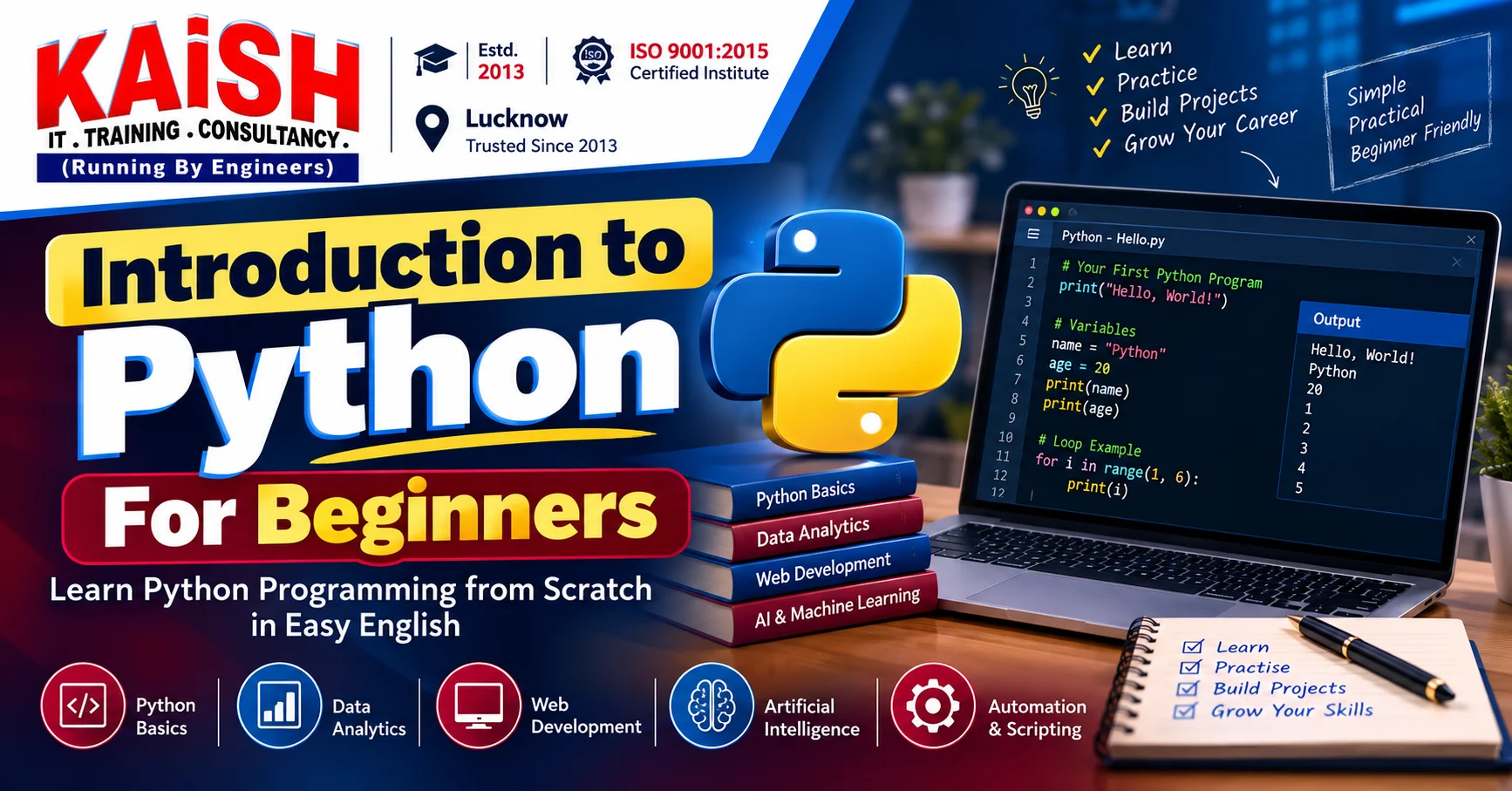
Introduction to Python for Beginners: A Simple Guide
📚 Table of Contents
Python is a beginner-friendly programming language used for software development, data analytics, artificial intelligence, web development, and automation. Learn Python basics with simple examples and start your programming journey.
📌 Quick Summary
Are you new to programming and want to learn how to write computer programs? Introduction to Python for Beginners is the perfect starting point for un...
This article is written for beginners who want to learn and build a career in Introduction to Python for Beginners: A Simple Guide.
Are you new to programming and want to learn how to write computer programs? Introduction to Python for Beginners is the perfect starting point for understanding one of the world's most popular programming languages. Python is known for its simple syntax, readability, and wide range of applications.
In this beginner-friendly guide, you will learn what Python is, why it is popular, how to write your first Python program, and how Python can help you explore careers in programming, data analytics, artificial intelligence, and web development.
What Is Python?
Python is a high-level, general-purpose programming language. In simple words, Python allows us to give instructions to a computer using code that is relatively easy to read and understand.
Python was created by Guido van Rossum and was first released in 1991. Today, it is widely used in software development, data science, automation, artificial intelligence, and many other fields.
Why Should Beginners Learn Python?
1. Easy to Understand
Python uses readable syntax, making it a good first programming language for students and beginners.
2. Free to Use
Python is free and open source. You can download it and start practising without paying for a programming language licence.
3. Useful in Different Fields
Python is used in web development, data analytics, machine learning, artificial intelligence, automation, and scientific computing.
4. Helpful for Career Development
Python can help you build skills for roles such as Python Developer, Data Analyst, and Automation Developer. Advanced roles may require additional knowledge, projects, and experience.
How Does Python Work?
A Python program contains instructions that a computer executes through the Python interpreter. You write the code, run the program, and see the output.
- Write the Python code.
- Run it using a Python interpreter.
- Python executes the instructions.
- The result appears on the screen.
Your First Python Program
Let's write a simple program to display a message on the screen.
print("Hello, World!")Output:
Hello, World!The print() function displays information on the screen. The text inside quotation marks is the message that Python will display.
Basic Concepts of Python
1. Variables
A variable is a name used to store or refer to a value.
name = "Rahul"
age = 20

print(name)
print(age)
Here, name refers to the text Rahul, and age refers to the number 20.
2. Data Types
Data types describe the kind of value used in a program.
int: Whole numbers, such as 10 and 25.float: Decimal numbers, such as 10.5.str: Text, such as "Python".bool: Boolean values, such as True and False.
name = "Amit"
age = 21
marks = 85.5
is_student = True

print(name, age, marks, is_student)
3. Taking Input from the User
The input() function allows users to enter information.
name = input("Enter your name: ")
print("Welcome", name)
If the user enters Amit, the program displays Welcome Amit.
4. Operators
Operators perform calculations and comparisons.
+Addition-Subtraction*Multiplication/Division%Remainder
a = 10
b = 5

print(a + b)
print(a - b)
print(a * b)
print(a / b)
5. Conditional Statements
Conditional statements allow a program to make decisions based on conditions.
marks = 75

if marks >= 33:
    print("Pass")
else:
    print("Fail")
Because the marks are greater than or equal to 33, the program displays Pass.
6. Loops
Loops repeat instructions and reduce the need to write the same code multiple times.
for i in range(1, 6):
    print(i)
This program displays the numbers 1 to 5.
7. Functions
A function is a reusable block of code that performs a particular task.
def greet():
    print("Welcome to Python!")

greet()
The def keyword defines a function, and greet() calls it.
How to Install Python
- Visit the official website: Python.org.
- Download the suitable Python version for your operating system.
- Install Python on your computer.
- Open IDLE or a code editor such as Visual Studio Code.
- Write and run your first Python program.
You can also use an online Python editor if you want to practise without installing software.
Where Is Python Used?
Python for Data Analytics
Python helps clean, process, analyse, and visualise data. Popular libraries include Pandas, NumPy, and Matplotlib.
Python for Artificial Intelligence
Python is widely used to build AI applications and machine learning models.
Python for Web Development
Frameworks such as Django and Flask help developers create web applications.
Python for Automation
Python can automate repetitive tasks, process files, and work with spreadsheets.
Python for Data Science
Python supports statistical analysis, data exploration, predictive modelling, and visualisation.
Python Learning Roadmap for Beginners
- Introduction to programming and Python.
- Variables, data types, and input/output.
- Operators and conditional statements.
- Loops and control flow.
- Strings, lists, tuples, sets, and dictionaries.
- Functions and recursion.
- File handling and exception handling.
- Object-oriented programming basics.
- Practical projects and problem-solving.
- Specialise in data analytics, AI, web development, or automation.
Python Projects for Beginners
Practise your knowledge by creating small projects such as:
- Simple calculator
- Student marks calculator
- Number guessing game
- Multiplication table generator
- Student record management program
- Basic expense tracker
Building projects helps you understand how programming concepts work together to solve real problems.
Frequently Asked Questions About Python
Is Python easy for beginners?
Yes. Python has readable syntax and is commonly recommended as a first programming language. Regular practice is important for developing programming skills.
Do I need mathematics to learn Python?
You can start learning basic Python without advanced mathematics. Specialised areas such as machine learning and data science may require additional mathematical knowledge.
Can I learn Python without programming experience?
Yes. Start with variables, data types, operators, and simple programs, then gradually move to loops, functions, and projects.
How long does it take to learn Python?
The time depends on your practice schedule and learning goals. Basic concepts may take a few weeks, while job-ready skills usually require further study and practical projects.
Is Python useful for Data Analytics?
Yes. Python is widely used for data cleaning, calculations, analysis, and visualisation with libraries such as Pandas, NumPy, and Matplotlib.
What can I do after learning Python?
You can explore programming, web development, automation, data analytics, AI, and data science. Your career options depend on your additional skills and practical experience.
Conclusion
Python is a beginner-friendly programming language that provides a strong foundation for learning programming. Start with simple examples, practise every concept, and build small projects as your confidence grows.
Learning Python can be your first step towards exploring data analytics, artificial intelligence, web development, and other technology-driven careers.
Learn Technology Skills with KAiSH Computer Institute, Lucknow
KAiSH Computer Institute helps learners explore practical computer and technology training aligned with their learning and career goals.
Visit KAiSH Computer Institute to explore available courses and training programmes.
KAiSH Computer Institute — Where Futures Are Coded.
🔗 Related Articles
https://kaishclasses.com/👉 Want to start your career? Join KAiSH Computer Institute today.