
SQL Course Syllabus 2026: 45 Days SQL Training in Lucknow for Data Analysis
📚 Table of Contents
Complete 45-day SQL Course Syllabus 2026 covering database fundamentals, SQL queries, joins, aggregate functions, subqueries, CTEs, advanced SQL, real-world projects and interview preparation. Join KAiSH Computer Institute, Aliganj, Lucknow for practical SQL training.
📌 Quick Summary
SQL Course Syllabus 2026: Complete 45 Days SQL Training Guide Looking for a SQL Course in Lucknow that goes beyond basic queries? The KAiSH SQL T...
This article is written for beginners who want to learn and build a career in SQL Course Syllabus 2026: 45 Days SQL Training in Lucknow for Data Analysis.
SQL Course Syllabus 2026: Complete 45 Days SQL Training Guide
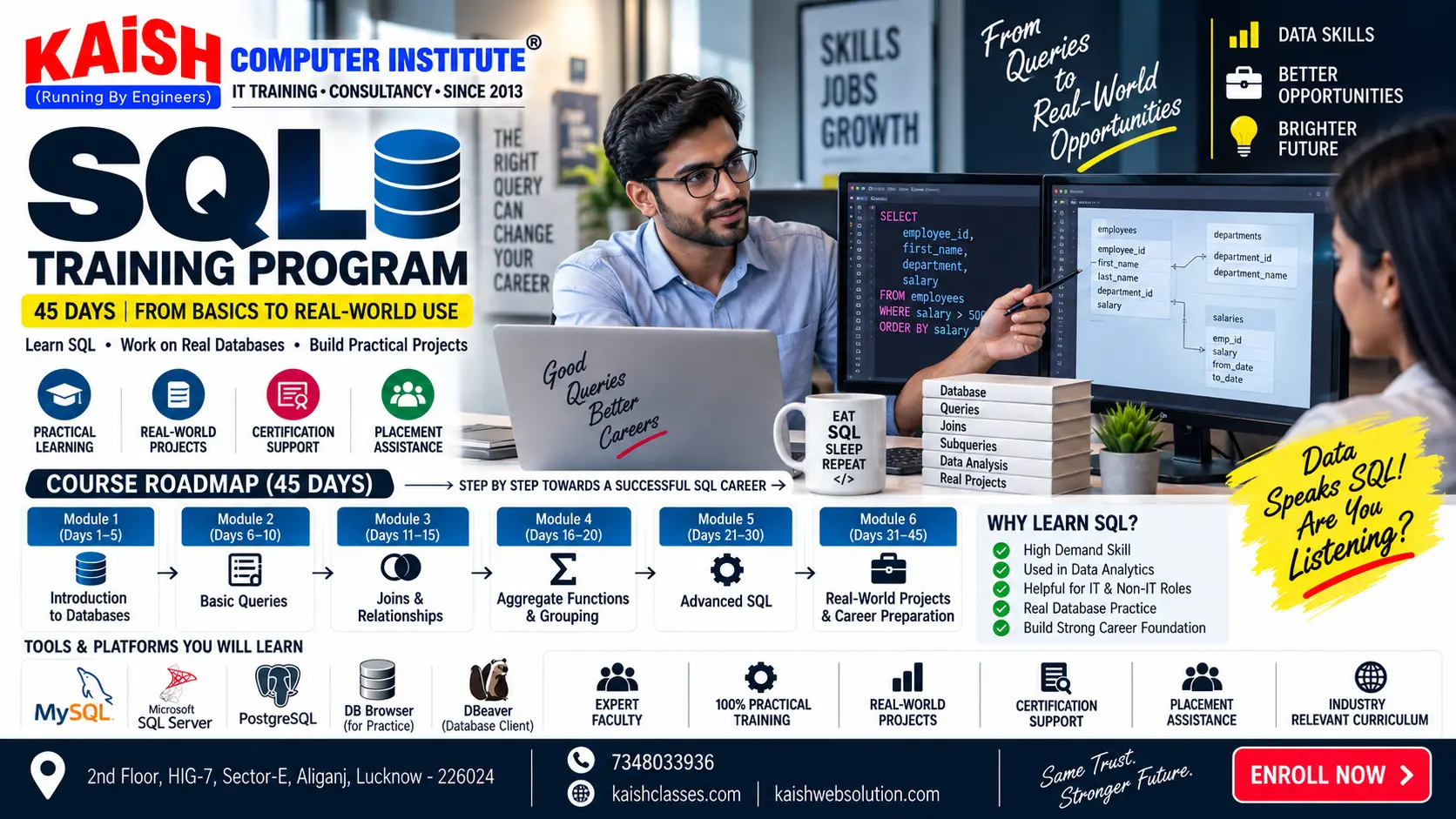
Looking for a SQL Course in Lucknow that goes beyond basic queries? The KAiSH SQL Training Program is a structured 45-day practical course designed to take beginners from database fundamentals to advanced SQL, real-world data analysis and project-based learning.
SQL is one of the most important skills for working with structured data and databases. It is widely used in data analysis, reporting, business intelligence, software applications and database management.
The KAiSH SQL Course focuses on hands-on SQL practice, real databases, practical projects, advanced queries and career preparation so that students can learn how SQL is actually used in professional environments.
What is SQL?
SQL stands for Structured Query Language. It is used to communicate with relational databases to store, retrieve, update and analyse data.
For example, SQL can help a business answer questions such as:
- Which products generated the highest sales?
- Who are the top customers?
- Which department has the highest expenses?
- How many employees are working in each department?
- Which month had the highest revenue?
- Which customers have not placed an order recently?
Learning SQL allows students to move from simply viewing data to actually querying, analysing and extracting useful information from databases.
SQL Course Syllabus at a Glance
| Module | Duration | Topics |
|---|---|---|
| Module 1 | Days 1–5 | Introduction to Databases |
| Module 2 | Days 6–10 | Basic SQL Queries |
| Module 3 | Days 11–15 | Joins & Relationships |
| Module 4 | Days 16–20 | Aggregate Functions & Grouping |
| Module 5 | Days 21–30 | Advanced SQL |
| Module 6 | Days 31–45 | Real-World Projects & Career Preparation |
Module 1: Introduction to Databases
The first module builds the foundation of database concepts and prepares beginners for practical SQL learning.
Topics Covered
- What is a Database?
- Database Management System
- RDBMS Concepts
- Tables, Rows and Columns
- SQL Overview
- DDL, DML and DCL Concepts
- CREATE
- ALTER
- DROP
- Data Types
- Constraints
- Primary Key
- Foreign Key
Practical Learning
Students create databases and tables and learn how structured business information is stored inside relational databases.
Module 2: Basic SQL Queries
After understanding databases, students start writing SQL queries to retrieve and filter information.
Topics Covered
- SELECT Statement
- FROM Clause
- WHERE Clause
- Comparison Operators
- AND / OR
- IN
- BETWEEN
- LIKE
- DISTINCT
- ORDER BY
- LIMIT / TOP
- Filtering & Sorting
Practical SQL Questions
- Find all customers from a particular city
- Find products above a specific price
- Display top-performing employees
- Sort customers by sales
- Find unique departments
- Search records using patterns
Module 3: SQL Joins & Relationships
Real business databases normally contain multiple related tables. SQL JOINs allow us to combine information from these tables.
Joins Covered
- INNER JOIN
- LEFT JOIN
- RIGHT JOIN
- FULL JOIN
- CROSS JOIN
- SELF JOIN
Relationship Concepts
- Primary Key & Foreign Key
- One-to-One Relationships
- One-to-Many Relationships
- Many-to-Many Concepts
- Combining Multiple Tables
Real-World JOIN Examples
Students practise combining customer, order, product, employee and department tables to create meaningful business reports.
Module 4: Aggregate Functions & Grouping
Aggregate functions are essential for business reporting and data analysis.
Functions Covered
- COUNT()
- SUM()
- AVG()
- MIN()
- MAX()
GROUP BY & HAVING
- GROUP BY
- HAVING
- Grouped Calculations
- Department-wise Analysis
- Customer-wise Sales
- Product-wise Performance
- Month-wise Revenue
Date & String Functions
- Date Functions
- String Functions
- NULL Handling
- CASE Statements
Module 5: Advanced SQL
The advanced SQL module focuses on techniques used to solve more complex data analysis and reporting problems.
Topics Covered
- Subqueries
- Nested Queries
- Correlated Subqueries
- Common Table Expressions (CTE)
- Views
- Indexes
- Window Functions
- Stored Procedures
- Triggers
- Advanced Query Practice
Window Functions
Students learn how window functions can be used for advanced analytical tasks such as ranking, running totals and comparisons between records.
CASE Statements
CASE expressions are used to create business categories and conditional logic, such as High, Medium and Low performance.
Module 6: Real-World SQL Projects & Career Preparation
The final stage focuses on applying SQL skills to practical business datasets and preparing students for SQL-related interviews and workplace tasks.
Project Areas
- Sales Data Analysis
- Customer Data Analysis
- Employee Data Analysis
- Product Performance Analysis
- Business Reporting
- Database Reporting
- Real-World SQL Queries
Career Preparation
- SQL Interview Questions
- Query-Based Interview Practice
- Problem-Solving Exercises
- Resume Guidance
- Project Presentation
- Interview Preparation
SQL Tools & Platforms You Will Learn
- MySQL
- Microsoft SQL Server
- PostgreSQL
- DB Browser
- DBeaver
The purpose of using multiple database platforms is to help students understand SQL concepts that can be applied across different relational database environments.
SQL Practical Learning Approach
The KAiSH SQL program is designed around practical learning. Students do not simply memorize SQL commands; they practise writing queries and solving data-related problems.
The learning process follows:
Learn → Write Queries → Work with Databases → Analyse Data → Build Projects → Prepare for Interviews
Real-World SQL Project Workflow
A typical project can follow this workflow:
Business Problem → Database → Tables → SQL Queries → Data Analysis → Report → Business Insights
For example, students may analyse a sales database to identify top customers, best-selling products, monthly revenue and underperforming categories.
What Can You Do After Learning SQL?
SQL is a foundational skill that can support several technology, reporting and analytics career paths.
- Data Analyst – Entry Level
- Junior Data Analyst
- MIS Analyst
- Reporting Analyst
- Business Intelligence – Entry Level
- Database Support Roles
- SQL Developer – Entry Level
- Data Reporting Executive
- Operations Analyst
Actual job requirements vary by company and role, so students should combine SQL with other relevant skills such as Excel, Power BI, programming or database administration depending on their career goal.
Who Should Join a SQL Course?
- 12th Pass Students
- Graduates
- BCA Students
- BBA Students
- B.Com Students
- B.Sc Students
- MCA / MBA Students
- Working Professionals
- Excel & MIS Professionals
- Aspiring Data Analysts
- Beginners Interested in Databases
- Students Preparing for Technical Interviews
Is SQL Difficult for Beginners?
SQL is generally beginner-friendly because its basic commands use a relatively readable structure. The important part is regular practice.
Students can start with SELECT and WHERE and gradually move towards JOINs, GROUP BY, subqueries, CTEs and window functions.
SQL Course Duration in Lucknow
The KAiSH SQL Training Program is structured as a 45-day training program.
The course progresses from database fundamentals and basic queries to joins, aggregate functions, advanced SQL, real-world projects and career preparation.
Why Learn SQL?
- Work with Structured Data
- Analyse Large Data Tables
- Create Database Reports
- Extract Business Information
- Build Data Analysis Skills
- Strengthen Your Data Career Foundation
- Prepare for SQL-Based Interviews
SQL Course in Lucknow
If you are searching for a SQL Course in Lucknow, SQL Training in Lucknow, or SQL Classes in Aliganj, KAiSH Computer Institute offers a practical 45-day SQL learning program focused on databases, SQL queries, joins, advanced SQL, data analysis and real-world projects.
The institute is located in Aliganj, Lucknow, making it a convenient option for students and working professionals looking for practical computer and technology training.
Why Choose KAiSH for SQL Training?
- 45-Day Structured SQL Training
- Hands-on SQL Practice
- Real Database Practice
- Beginner to Advanced SQL
- Real-World Projects
- Practical Assignments
- SQL Interview Preparation
- Certification Support
- Placement Assistance
- Career Guidance
- Industry-Relevant Curriculum
SQL Learning Roadmap: From Beginner to Job-Ready
- Understand Databases
- Learn Basic SQL Queries
- Master Filtering & Sorting
- Learn SQL Joins
- Master GROUP BY & Aggregate Functions
- Learn Subqueries & CTEs
- Understand Window Functions
- Work on Real-World Datasets
- Build SQL Projects
- Prepare for SQL Interviews
Frequently Asked Questions About SQL Course
What is the SQL Course Syllabus in 2026?
A comprehensive SQL course syllabus includes database fundamentals, SQL queries, filtering, sorting, joins, aggregate functions, GROUP BY, HAVING, subqueries, CTEs, views, indexes, window functions, advanced SQL and practical projects.
What is the duration of the KAiSH SQL Course?
The KAiSH SQL Training Program is designed as a 45-day program covering basic to advanced SQL and real-world project work.
Is SQL suitable for beginners?
Yes. The course starts with database fundamentals and basic SQL queries before gradually moving to joins, grouping, subqueries and advanced SQL concepts.
Is SQL useful for Data Analysis?
Yes. SQL is widely used to retrieve, filter, combine and analyse structured data from relational databases, making it an important skill for many data and reporting roles.
Which SQL databases are covered?
The program provides practical exposure to platforms such as MySQL, Microsoft SQL Server and PostgreSQL, along with database tools such as DB Browser and DBeaver.
Will I work on real SQL projects?
Yes. The final stage of the program focuses on real-world style datasets, SQL analysis, business reporting and practical projects.
Can I learn SQL without coding experience?
Yes. SQL can be learned by beginners without prior programming experience. Regular hands-on query practice is important for developing confidence.
What jobs can I target after learning SQL?
Depending on your overall skills and experience, you can explore roles such as Junior Data Analyst, MIS Analyst, Reporting Analyst, Data Reporting Executive, SQL Developer – Entry Level and other database or analytics-related positions.
Where can I learn SQL in Lucknow?
Students searching for practical SQL training in Lucknow can explore KAiSH Computer Institute in Aliganj, Lucknow, where the 45-day program covers databases, SQL queries, joins, advanced SQL and real-world projects.
Start Learning SQL with KAiSH
Learn SQL. Practise Queries. Analyse Data. Build Real Skills.
If you want to develop practical SQL and database skills for data analysis, reporting or technology-related careers, start your SQL learning journey with KAiSH Computer Institute.
KAiSH Computer Institute
IT Training & Consultancy | Running By Engineers | Since 2013
Location: 2nd Floor, HIG-7, Sector-E, Aliganj, Lucknow - 226024
Phone: 7348033936
Website: kaishclasses.com
Learn • Practice • Build • Get Placed
🔗 Related Articles
https://www.kaishclasses.com/sql-mysql-course-lucknow.php https://www.kaishclasses.com/advanced-excel-course-in-lucknow.php👉 Want to start your career? Join KAiSH Computer Institute today.