
Data Science Training in Lucknow: Career Guide, Skills, Tools & Projects
📚 Table of Contents
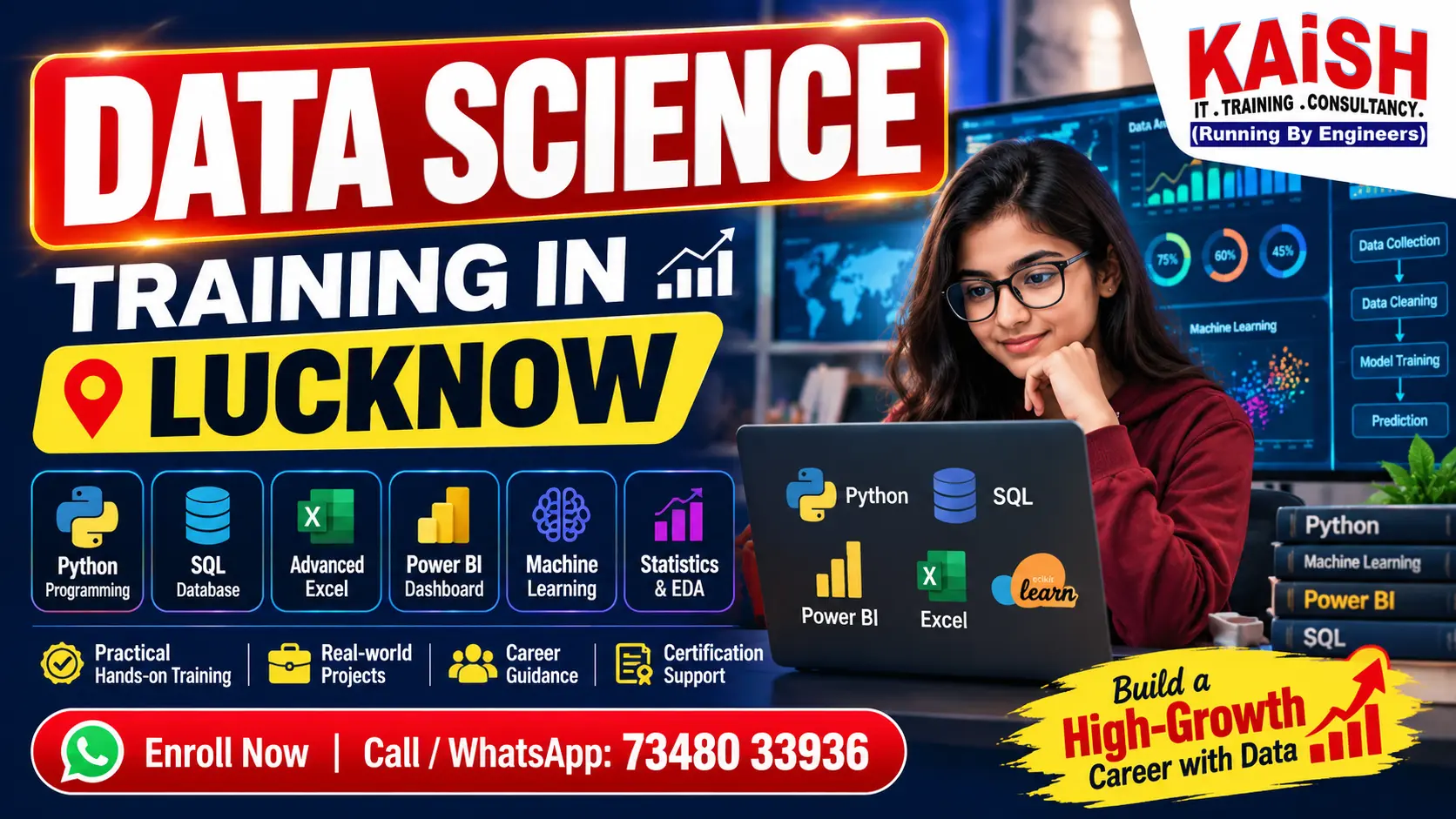
Looking for Data Science training in Lucknow? Learn how Python, SQL, Advanced Excel, Power BI, statistics and machine learning work together to solve real-world business problems. This student-friendly career guide explains eligibility, essential skills, practical projects and career paths, and helps you choose the right Data Science training program at KAiSH Computer Institute, Aliganj, Lucknow.
📌 Quick Summary
Data Science Training in Lucknow: Career Guide, Skills, Tools & Projects Are you a student, graduate, working professional or beginner wh...
This article is written for beginners who want to learn and build a career in Data Science Training in Lucknow: Career Guide, Skills, Tools & Projects.
Data Science Training in Lucknow: Career Guide, Skills, Tools & Projects
Are you a student, graduate, working professional or beginner who wants to build a career in Data Science? Companies use data to understand customers, improve business performance, forecast sales and make better decisions. But how do you learn these skills, and where should you begin?
Choosing the right Data Science training in Lucknow can help you move from theoretical knowledge to practical problem-solving. Before joining a course, understand the tools, programming concepts, projects and career opportunities involved.
KAiSH Computer Institute, Aliganj, Lucknow, established in 2013, provides computer and IT training across several career-oriented disciplines. Explore this guide to understand the Data Science learning roadmap and the questions you should ask before selecting a training program.
What Is Data Science?
Data Science is the process of using data, statistics, programming and analytical techniques to discover patterns, answer questions and support decision-making.
For example, a retail business can analyse historical sales to identify best-selling products. A bank can examine transaction patterns to identify potentially fraudulent activity. An online business can study customer behaviour to understand purchasing trends.
Data Science combines several important skills:
- Data collection, cleaning and preparation
- Statistics and probability
- Python programming and SQL databases
- Data visualization and business reporting
- Machine Learning and predictive modelling
- Critical thinking and business problem-solving
The objective is not simply to write code. It is to convert data into meaningful insights that support informed decisions.
Data Science vs Data Analytics: What Is the Difference?
Data Analytics primarily focuses on understanding historical performance, identifying trends and communicating findings through reports and dashboards. Data Science includes these foundations and can extend into statistical modelling, machine learning and prediction.
For example, a sales analyst may use Excel, SQL and Power BI to identify which products performed best last month. A Data Scientist may develop and evaluate a model to forecast future demand using historical data and relevant variables.
These fields overlap in practice. Learning Data Analytics first can provide a valuable foundation for students who want to progress towards Data Science.
Which Tools Should You Learn for Data Science?
A practical learning roadmap should cover the complete journey from raw data to useful insights. Beginners do not need to master every tool at once.
1. Advanced Excel and Power Query
Excel is a practical starting point for understanding tabular data, business reporting and data preparation.
- Formulas, functions and logical calculations
- IF, SUMIFS, COUNTIFS and lookup functions
- Sorting, filtering and data validation
- PivotTables, PivotCharts and dashboards
- Power Query for importing and transforming data
Practice project: Analyse a sales dataset to identify monthly revenue, top-performing products, regional performance and profit margins.
2. SQL for Data Analysis
SQL helps you retrieve, filter and analyse information stored in relational databases.
- SELECT, WHERE, ORDER BY and DISTINCT
- Aggregate functions and GROUP BY
- INNER JOIN, LEFT JOIN and other joins
- CASE statements and subqueries
- Common Table Expressions and window functions
Practice project: Analyse customer, order and product tables to calculate revenue, repeat purchases and product performance.
3. Python Programming for Data Science
Python is widely used for data processing, analysis, automation and machine learning. Begin with variables, data types, conditions, loops, functions, lists, dictionaries and modules.
- NumPy: Numerical operations and arrays
- Pandas: Data cleaning, transformation and analysis
- Matplotlib: Charts and visualizations
- Seaborn: Statistical data visualization
- Scikit-learn: Machine Learning workflows
Practise using Jupyter Notebook or another suitable Python development environment.
Practice project: Clean a customer dataset, calculate summary statistics, identify missing values and visualize monthly trends.
4. Statistics and Probability
Statistics helps you interpret data correctly, understand uncertainty and evaluate analytical results.
- Mean, median, mode and standard deviation
- Probability and distributions
- Sampling and population
- Correlation and covariance
- Confidence intervals and hypothesis testing
- Basic experimental analysis
Learn what statistical results mean, when they are useful and what limitations they have.
5. Power BI and Data Visualization
Power BI helps transform data into interactive reports and dashboards. Learn data import, Power Query, data modelling, relationships, DAX measures, KPI cards, charts and slicers.
Tableau is another visualization platform worth exploring, depending on your career goals and the tools used by your target employers.
Practice project: Create an interactive business dashboard showing revenue, profit, sales growth, regional performance and product trends.
6. Machine Learning
Machine Learning enables computers to identify patterns in data and use those patterns to make predictions or group observations.
- Supervised and unsupervised learning
- Linear and logistic regression
- Decision trees and random forests
- K-nearest neighbours and K-means clustering
- Model training, testing and evaluation
- Overfitting, feature engineering and data leakage
A good learning program should explain how algorithms work and how to evaluate their results. Advanced topics such as deep learning and natural language processing can follow after the foundations.
Do You Need Coding to Start Data Science?
You do not need to be an experienced programmer before beginning. However, programming becomes important as you progress towards professional Data Science and Machine Learning work.
If you are new to coding, start with computer fundamentals, Excel, basic statistics and Python. Then progress to SQL, Pandas, visualization and machine learning.
If you already know Python, focus more on data manipulation, statistical reasoning, model evaluation and practical projects.
Who Can Learn Data Science?
Data Science may be suitable for:
- BCA, B.Sc., B.Tech., MCA and other graduates interested in data-related careers
- Commerce and management students interested in business analytics
- Finance and accounting learners who want to analyse financial data
- Working professionals who want to develop analytical skills
- Beginners willing to learn programming, mathematics and problem-solving
The mathematics and programming required depend on the target role. Business reporting roles may emphasize Excel, SQL and Power BI, while advanced modelling roles typically require stronger programming, statistics and machine learning skills.
Practical Data Science Projects You Should Build
Practical projects help demonstrate what you can do with data. Build a portfolio that explains the problem, dataset, cleaning steps, methodology, results and limitations.
Project 1: Retail Sales Analysis
Tools: Excel, SQL and Power BI.
Analyse sales, revenue, profit, product categories and regional performance. Present findings in a dashboard and explain the business decisions your analysis could support.
Project 2: Customer Churn Analysis
Tools: Python, Pandas, visualization and Machine Learning.
Explore customer behaviour and identify patterns associated with customers leaving a service. Evaluate any predictive model on data that was not used during training.
Project 3: Financial Data Analysis
Tools: Python, Excel and Power BI.
Study historical financial data, calculate key performance measures and visualize trends. Clearly distinguish historical analysis from forecasts or investment recommendations.
Project 4: E-commerce Customer Insights
Tools: SQL, Python and data visualization.
Analyse order history, customer segments, purchase frequency and product preferences to identify useful business patterns.
Project 5: Student Performance Analysis
Tools: Python, Pandas, statistics and visualization.
Explore how attendance, study time and other available variables relate to academic outcomes. Protect personal information and avoid treating correlation as proof of causation.
Career Opportunities After Data Science Training
Depending on your skills, portfolio and experience, you may explore career paths such as:
- Junior Data Analyst
- Business Intelligence Analyst
- Reporting or MIS Analyst
- Junior Python Data Analyst
- Data Science Intern
- Junior Machine Learning Practitioner
- Data Scientist, after developing the required advanced skills and experience
Not every learner is immediately qualified for every role. Employers may evaluate SQL, Python, statistics, visualization, communication and project experience differently. Review current job descriptions for your target role and use their requirements to guide your learning plan.
How to Choose the Right Data Science Institute in Lucknow
Before paying your course fees, compare institutes on the quality of teaching and practical learning, rather than just the number of tools listed in an advertisement.
- Does the course match my current skill level?
- Will I practise Excel, SQL, Python, statistics and visualization where relevant?
- Are assignments based on realistic datasets?
- Will I build projects that I can explain during an interview?
- Can I review the detailed syllabus, duration, fees and batch timings?
- Can the trainer explain concepts and provide feedback on assignments?
- What career guidance or placement assistance is actually included?
- Can I discuss a sample class or attend counselling before enrolling?
A transparent institute should explain what the program covers, what you need to practise independently and which outcomes cannot be guaranteed.
Learn Data Science at KAiSH Computer Institute, Aliganj, Lucknow
If you are searching for Data Science training in Lucknow, KAiSH Computer Institute is a local option to explore for career-oriented IT education.
Established in 2013, KAiSH Computer Institute is located in the Aliganj–Kapoorthala area of Lucknow, Uttar Pradesh. Its training areas include Data Science, Data Analytics, Python programming, AI and other computer-related disciplines.
A practical learning roadmap may include:
- Excel and data fundamentals
- SQL and database analysis
- Python programming
- Pandas, NumPy and data visualization
- Statistics and exploratory data analysis
- Power BI dashboards and business reporting
- Machine Learning fundamentals
- Portfolio projects and interview preparation
The sequence can be adjusted according to your background and career objectives. Confirm the exact modules included in the current program before admission.
Institute: KAiSH Computer Institute
Location: Aliganj–Kapoorthala, Lucknow, Uttar Pradesh
Established: 2013
Phone/WhatsApp: +91 73480 33936
Explore Data Science Course in Lucknow to review the available course information.
Want to Know Which Data Science Learning Path Is Right for You?
Do not choose a course simply because Data Science is trending. Choose a learning path that matches your background, available time and career objective.
Contact KAiSH Computer Institute to discuss your current skills and learning goals. Ask for the latest syllabus, fee structure, batch timings and practical project details before enrolling.
Call or WhatsApp: +91 73480 33936
Visit KAiSH Computer Institute in Aliganj, Lucknow, and take the first step towards developing practical data skills through structured learning and consistent practice.
Frequently Asked Questions (FAQs)
1. What is the best way to start learning Data Science in Lucknow?
Start with data fundamentals, Excel and basic statistics. Then learn SQL, Python, visualization and machine learning according to your goals. Choose a program that includes guided practice and meaningful projects.
2. Can a beginner join Data Science training?
Yes. Beginners can start with foundational computer skills and programming. A structured learning path helps them progress from basic concepts to data analysis and machine learning.
3. Is Python necessary for Data Science?
Python is one of the most widely used programming languages in Data Science. It supports data manipulation, visualization, statistical analysis and machine learning. Some introductory analytics tasks can be completed using spreadsheet and BI tools, but Python is important for broader Data Science work.
4. Should I learn Excel, SQL and Power BI before Machine Learning?
For many beginners, learning Excel, SQL and visualization before Machine Learning is a practical approach. These skills build data-handling and analytical foundations. The exact order depends on your existing knowledge and learning objectives.
5. What is the difference between Data Science and Data Analytics courses?
Data Analytics courses generally emphasize data cleaning, reporting, dashboards and business insights. Data Science courses often include these foundations and extend into statistics, predictive modelling and machine learning. Course content varies by provider, so compare the actual syllabus.
6. What projects should I complete during Data Science training?
Begin with retail sales analysis, customer segmentation, financial data analysis, e-commerce insights and interactive dashboards. Progress towards machine learning projects once you understand data preparation, statistics and model evaluation.
7. How do I choose a Data Science course in Lucknow?
Review the syllabus, trainer experience, hands-on practice, project work, duration, fees and career support. Ask for specific details rather than relying only on promotional claims.
8. Where can I enquire about Data Science training at KAiSH Computer Institute?
Visit the Data Science course page or call/WhatsApp +91 73480 33936 to enquire about the current program, fees, batch timings and syllabus.
About the Publisher
KAiSH Computer Institute is a computer and IT training institute established in 2013 in Aliganj, Lucknow, Uttar Pradesh. Its training areas include Data Science, Data Analytics, Python programming, AI, web development and other career-oriented digital skills. Visit KAiSH Computer Institute to learn more.
🔗 Related Articles
https://www.kaishclasses.com/data-science-course-lucknow.php https://www.kaishclasses.com/🌐 References
https://developers.google.com/search/docs/fundamentals/creating-helpful-content https://developers.google.com/search/docs/essentials👉 Want to start your career? Join KAiSH Computer Institute today.