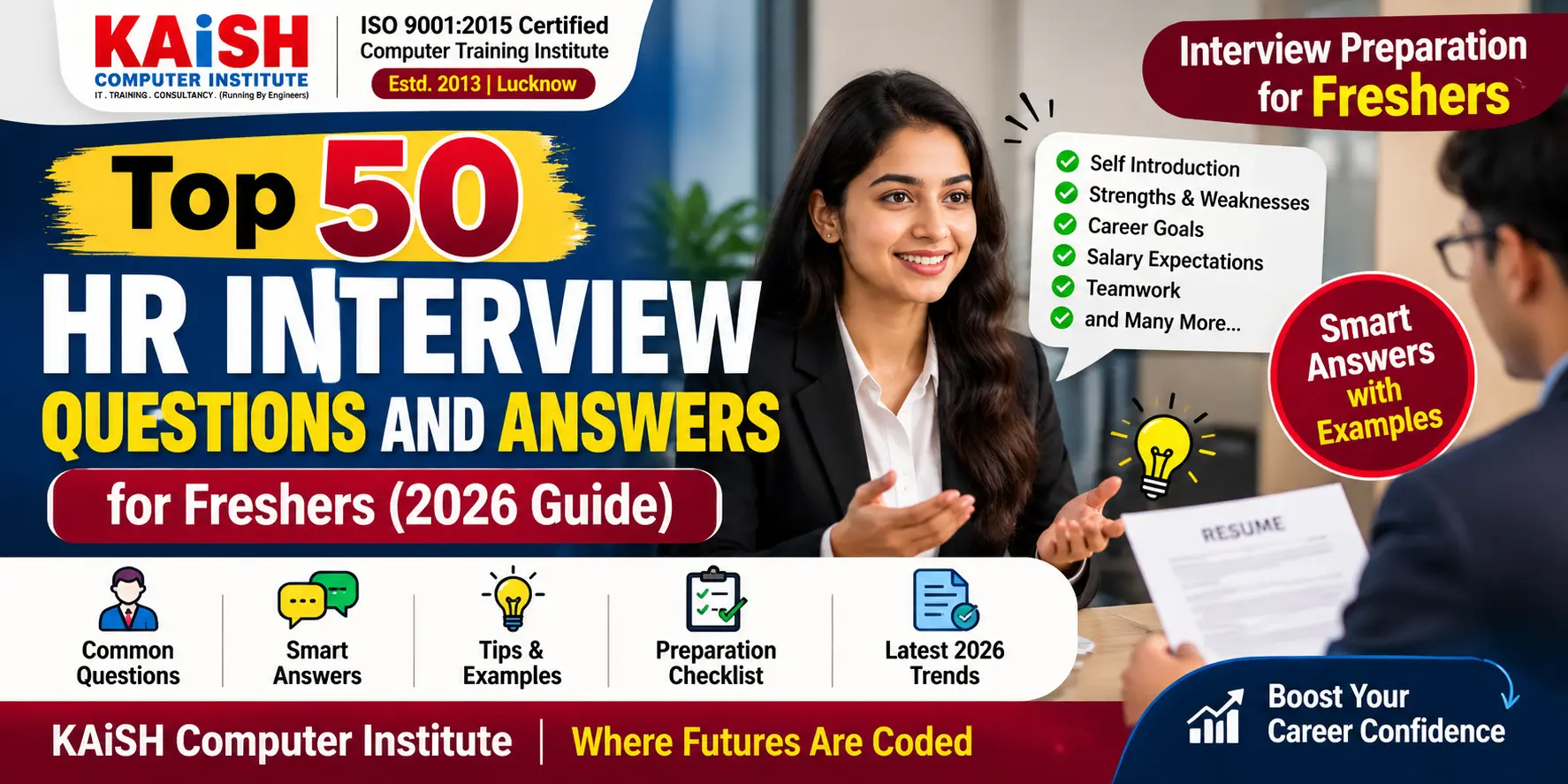
Top 50 HR Interview Questions & Smart Answers for Freshers (2026 Guide)
📚 Table of Contents
Preparing for an HR interview? This complete guide covers the top 50 HR interview questions and smart sample answers for freshers in 2026. Learn how to answer questions about self-introduction, strengths, weaknesses, salary expectations, teamwork, career goals, conflicts, relocation, pressure and more with confidence.
📌 Quick Summary
Top 50 HR Interview Questions and Smart Answers for Freshers Preparing for your first job interview can be challenging, especially when you are not...
This article is written for beginners who want to learn and build a career in Top 50 HR Interview Questions & Smart Answers for Freshers (2026 Guide).
Top 50 HR Interview Questions and Smart Answers for Freshers
Preparing for your first job interview can be challenging, especially when you are not sure what questions an HR interviewer may ask. The good news is that many HR interview questions are based on common themes such as self-introduction, strengths and weaknesses, career goals, teamwork, communication, problem-solving, salary expectations and workplace situations.
In this guide, we have compiled the Top 50 HR Interview Questions and Answers for Freshers to help students and job seekers prepare for their HR round with confidence.
Remember: Do not memorize these answers word-for-word. Use them as a framework and customize them according to your education, skills, projects, internship experience and career goals.
What Does an HR Interviewer Look For?
During an HR interview, recruiters generally want to understand your communication skills, confidence, attitude, motivation, adaptability, teamwork ability and suitability for the role.
- Communication skills
- Confidence and professionalism
- Positive attitude
- Willingness to learn
- Teamwork and collaboration
- Problem-solving ability
- Career motivation
- Company and role awareness
- Adaptability and flexibility
- Professional behaviour
Top 50 HR Interview Questions and Smart Answers
1. Tell me about yourself.
Smart Answer: "I am a recent graduate with a strong interest in developing my professional skills. During my education, I worked on academic projects that helped me improve my problem-solving, communication and technical skills. I am now looking for an opportunity where I can apply what I have learned, contribute to the organization and continue developing professionally."
Tip: Keep your introduction relevant to the job and preferably within 60–90 seconds.
2. Why do you want to join our company?
Smart Answer: "I am interested in joining your company because of its reputation, work culture and the opportunities it provides for professional growth. I have also researched the role and believe my skills and career goals align well with this position."
Tip: Research the company before your interview.
3. Why should we hire you?
Smart Answer: "As a fresher, I may not have extensive professional experience, but I bring a strong willingness to learn, a positive attitude and relevant skills. I am comfortable taking responsibility, learning new technologies and working with a team. I believe I can grow quickly while contributing to the organization."
4. What are your strengths?
Smart Answer: "My key strengths are consistency, willingness to learn and problem-solving. When I face something unfamiliar, I try to understand it systematically and improve through practice."
Tip: Mention strengths that are relevant to the job and support them with examples.
5. What is your biggest weakness?
Smart Answer: "Earlier, I sometimes spent too much time trying to make my work perfect. I have been improving this by setting priorities, managing deadlines and focusing on delivering quality work within the required time."
Tip: Never say "I have no weakness." Show self-awareness and improvement.
6. Where do you see yourself in five years?
Smart Answer: "In five years, I would like to become a skilled professional with strong expertise in my field, take greater responsibility and contribute to important projects. I also want to continue learning and growing with the organization."
7. Why did you choose this career?
Smart Answer: "I chose this career because I enjoy learning, solving problems and developing practical skills. During my education, I became increasingly interested in this field and decided to build my career around it."
8. What do you know about our company?
Smart Answer: "I researched your company before coming to the interview. I understand that your organization works in [industry/service] and focuses on [key product/service]. I was particularly interested in [specific company achievement/product/value]."
Tip: Replace the placeholders with actual company information.
9. Why should we select you over other candidates?
Smart Answer: "Every candidate has different strengths. What I can offer is a strong learning attitude, commitment, adaptability and willingness to take responsibility. I am ready to put in the effort required to learn and perform well in this role."
10. What motivates you?
Smart Answer: "Learning new things, solving problems and seeing measurable improvement in my work motivate me. I also feel motivated when I can contribute to a team and achieve a common goal."
11. Are you a team player?
Smart Answer: "Yes. I believe good teamwork requires communication, respect and accountability. I am comfortable sharing ideas, listening to others and taking responsibility for my part of the work."
12. Tell me about a time you worked in a team.
Smart Answer: "During one of my academic projects, I worked with a team where we divided responsibilities according to individual strengths. I handled my assigned part, communicated progress regularly and helped resolve issues when required. We successfully completed the project within the deadline."
13. How do you handle pressure?
Smart Answer: "I handle pressure by staying calm, prioritizing tasks and focusing on one important task at a time. If the workload is high, I divide it into smaller tasks and manage my time according to deadlines."
14. How do you handle failure?
Smart Answer: "I consider failure an opportunity to identify what went wrong and improve. I analyse the situation, learn from the mistake and make sure I apply that learning to future tasks."
15. Tell me about a failure and what you learned from it.
Smart Answer: "During an academic project, I underestimated the time required for one part of the work. It taught me the importance of planning and maintaining some buffer time. Since then, I have become more careful about estimating tasks and deadlines."
16. What is your greatest achievement?
Smart Answer: "One of my achievements was successfully completing [project/course/certification/competition] while managing my regular academic responsibilities. It improved my confidence and taught me the importance of consistency."
17. What are your short-term career goals?
Smart Answer: "My short-term goal is to start my career in a good organization, strengthen my practical skills and gain real-world experience while becoming productive in my role."
18. What are your long-term career goals?
Smart Answer: "My long-term goal is to become an experienced professional in my field, take greater responsibilities and eventually contribute to strategic projects and team development."
19. Why do you want this job?
Smart Answer: "This role matches my skills and career interests. I believe it will give me an opportunity to apply my knowledge in a practical environment while learning from experienced professionals."
20. Why should a fresher like you be hired?
Smart Answer: "A fresher brings a fresh perspective, learning ability and adaptability. I am ready to learn the company's processes, accept feedback and work consistently to become a valuable member of the team."
21. Are you willing to learn new technologies?
Smart Answer: "Absolutely. Continuous learning is important in today's professional environment. I am comfortable learning new tools, technologies and processes whenever the role requires them."
22. How do you respond to criticism?
Smart Answer: "I try to take constructive criticism positively. I listen carefully, understand the issue and work on improving it rather than taking feedback personally."
23. How do you handle conflict with a teammate?
Smart Answer: "I would first try to understand the other person's perspective and then discuss the issue calmly. My focus would be on finding a practical solution rather than proving who is right."
24. What would you do if your manager disagrees with you?
Smart Answer: "I would respectfully explain my point with facts or relevant information and listen to my manager's perspective. If the final decision is different from my suggestion, I would support the team's decision professionally."
25. What would you do if you made a mistake at work?
Smart Answer: "I would acknowledge the mistake, inform the appropriate person if necessary, correct it as quickly as possible and understand how to prevent the same mistake in the future."
26. Can you work under strict deadlines?
Smart Answer: "Yes. I understand that deadlines are part of professional work. I prioritize important tasks, plan my time and communicate early if I identify any potential issue."
27. Are you comfortable working with a team you have never worked with before?
Smart Answer: "Yes. I would first understand the team's working style and responsibilities, communicate openly and focus on building a professional working relationship."
28. Are you comfortable working independently?
Smart Answer: "Yes. I can manage assigned responsibilities independently, while also understanding when it is appropriate to ask for clarification or support."
29. What would you do if you did not know how to complete a task?
Smart Answer: "I would first try to understand the problem and research possible solutions. If I still needed help, I would ask an experienced colleague or manager specific questions rather than simply saying I cannot do it."
30. How do you prioritize your work?
Smart Answer: "I prioritize tasks based on urgency, importance and deadlines. I generally complete high-impact and time-sensitive tasks first while keeping track of other responsibilities."
31. What is your expected salary?
Smart Answer: "As a fresher, my priority is to get the right opportunity where I can learn and contribute. I am open to the company's standard compensation for this role and would be happy to discuss the package based on the responsibilities."
Tip: Research the typical salary range for your role, location and experience level.
32. Are you willing to relocate?
Smart Answer: "Yes, I am open to relocation if the role requires it. I would appreciate understanding the location and expectations so I can plan accordingly."
Only say yes if relocation is genuinely possible for you.
33. Are you comfortable working night shifts?
Smart Answer: "I understand that some roles may require rotational or night shifts. I am open to discussing the shift requirements and understanding the company's expectations."
34. Are you willing to sign a service agreement or bond?
Smart Answer: "I am open to understanding the terms and conditions of the agreement before making a decision. I would like to understand the duration, responsibilities and other applicable conditions."
35. Are you willing to work overtime when required?
Smart Answer: "I understand that there can be situations where additional effort is required to meet an important deadline. I am willing to support the team when genuinely required while maintaining a professional and sustainable work approach."
36. Why did you have a gap in your education or career?
Smart Answer: "During that period, I focused on [learning/preparation/personal responsibility/skill development]. The experience helped me become more disciplined and gave me time to improve my skills."
Tip: Be honest. Do not create a false explanation for a career or education gap.
37. Do you have any backlogs?
Smart Answer: "I had [number] backlog(s), which I successfully cleared. The experience taught me better time management and helped me become more disciplined about my studies."
If you have no backlog, simply state that clearly.
38. Why are your academic marks not very high?
Smart Answer: "My academic performance could have been better in some areas. However, I have focused on developing practical skills through projects, courses and continuous learning. I believe my practical abilities and willingness to improve are important strengths."
39. What makes you different from other candidates?
Smart Answer: "I focus on continuous learning and practical application. Whenever I learn something new, I try to apply it through projects or real-world practice. I believe this approach helps me improve faster."
40. What is your biggest professional strength?
Smart Answer: "My biggest professional strength is my willingness to learn and adapt. I am comfortable accepting feedback and changing my approach when it helps improve the quality of my work."
41. What kind of work environment do you prefer?
Smart Answer: "I prefer a professional and collaborative environment where people communicate openly, responsibilities are clear and employees have opportunities to learn and improve."
42. How do you handle multiple tasks at the same time?
Smart Answer: "I first list the tasks and identify their deadlines and priority. Then I create a simple plan and focus on completing high-priority work without compromising quality."
43. What would you do if you disagreed with a team decision?
Smart Answer: "I would respectfully explain my concern and provide supporting reasons. If the team decides to proceed with another approach, I would respect the decision and contribute toward making it successful."
44. How do you deal with a difficult customer or colleague?
Smart Answer: "I would remain calm, listen carefully and understand the actual concern. Instead of reacting emotionally, I would focus on finding a practical and professional solution."
45. What would you do if you received a task you considered difficult?
Smart Answer: "I would break the task into smaller parts, identify what I already know and research the areas I need to learn. If required, I would seek guidance from someone experienced."
46. What are you looking for in your first job?
Smart Answer: "I am looking for an opportunity where I can gain practical experience, learn from experienced professionals, contribute to meaningful work and build a strong foundation for my career."
47. Do you have any other job offers?
Smart Answer: "I am currently exploring opportunities that align with my skills and career goals. My focus is on finding a role where I can learn, contribute and grow professionally."
Always answer honestly if you have another offer.
48. Why should we believe you will stay with our company?
Smart Answer: "I am looking for long-term professional growth rather than simply a short-term opportunity. If I get an environment where I can learn, contribute and grow based on my performance, I would be interested in building a long-term career with the organization."
49. Do you have any questions for us?
Smart Answer: "Yes. I would like to know what success in this role looks like during the first six months and what kind of training or learning opportunities are available for new employees."
Tip: Always prepare 2–3 thoughtful questions for the interviewer.
50. Is there anything else you would like to tell us?
Smart Answer: "I would just like to add that I am genuinely interested in this opportunity. I am willing to learn, take responsibility and put in consistent effort to contribute to the organization. I would be grateful for the opportunity to demonstrate my abilities."
How to Answer HR Interview Questions Smartly
A good HR answer is not necessarily a long answer. The best answers are clear, relevant, honest and supported by a real example whenever possible.
Use the STAR Method for Behavioural Questions
- S – Situation: Explain the situation briefly.
- T – Task: Explain your responsibility.
- A – Action: Explain what you did.
- R – Result: Explain the outcome or learning.
The STAR method is especially useful for questions related to teamwork, conflict, leadership, failure, pressure and problem-solving.
Common HR Interview Mistakes Freshers Should Avoid
- Memorizing answers word-for-word
- Giving extremely long answers
- Speaking negatively about previous teachers, colleges or employers
- Giving false information
- Not researching the company
- Being unclear about your career goals
- Saying "I have no weakness"
- Giving unrealistic salary expectations
- Checking your phone during the interview
- Arriving late
- Not asking any question at the end
HR Interview Preparation Checklist for Freshers
- Prepare a 60–90 second self-introduction.
- Research the company and job description.
- Know your resume completely.
- Prepare examples of your projects and achievements.
- Prepare answers about strengths and weaknesses.
- Practice common HR questions aloud.
- Research the expected salary range.
- Prepare questions to ask the interviewer.
- Dress professionally.
- Keep your communication clear and confident.
Frequently Asked Questions About HR Interviews
What are the most common HR interview questions for freshers?
Some of the most common questions include "Tell me about yourself", "Why should we hire you?", "What are your strengths and weaknesses?", "Why do you want to join our company?", "Where do you see yourself in five years?", "What is your expected salary?" and questions about teamwork, pressure and career goals.
How should a fresher answer "Tell me about yourself"?
A fresher should briefly discuss their education, relevant skills, projects, achievements and career interests. Keep the answer professional, concise and connected to the job you are applying for.
What is the best answer for "Why should we hire you?"
Connect your skills, learning attitude and relevant experience to the requirements of the job. Avoid generic statements and provide specific examples whenever possible.
How can I prepare for an HR interview as a fresher?
Research the company, understand the job description, prepare your self-introduction, review your resume, practice common HR interview questions and prepare examples from your academic projects, internships or other experiences.
What should I say about salary expectations as a fresher?
Research the market range for the role and location. You can communicate that you are open to the company's standard compensation while considering the responsibilities and overall opportunity.
Should I memorize HR interview answers?
No. Memorizing answers can make your responses sound unnatural. Instead, understand the key points and practice answering in your own words.
Final Tips to Crack Your HR Interview
Success in an HR interview is not about giving a perfect answer to every question. Recruiters want to see confidence, honesty, communication skills, willingness to learn and professional behaviour.
Before your interview, practice your answers aloud, research the organization and prepare real examples from your education, projects, internships or previous experiences.
Remember: Be confident, stay honest, listen carefully and answer the question that was actually asked.
With the right preparation and consistent practice, you can approach your next HR round with much greater confidence.
Start Your Career With the Right Skills
For students and freshers, strong technical skills along with communication, interview preparation and professional skills can make a significant difference during job applications and placement interviews.
Keep learning, keep practising and keep improving.
KAiSH Computer Institute – Where Futures Are Coded.
🔗 Related Articles
https://www.kaishclasses.com/data-analytics-course-lucknow.php https://www.kaishclasses.com/full-stack-web-development-course-lucknow.php https://www.kaishclasses.com/digital-marketing-course.php https://www.kaishclasses.com/👉 Want to start your career? Join KAiSH Computer Institute today.