Introduction to C Programming Course in Lucknow
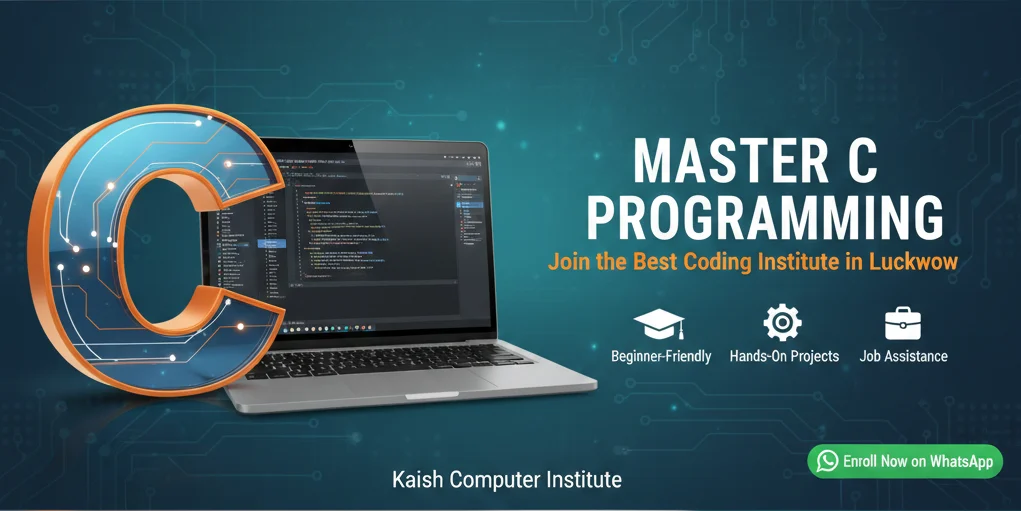
Kaish Computer Institute, Aliganj Lucknow offers the best C Programming Course in Lucknow designed for beginners and intermediate learners who want to build a strong foundation in computer programming. This job-oriented program covers every essential topic of the C language including data types, operators, control statements, loops, functions, arrays, pointers, structures, file handling and memory management. With our industry-focused C language training in Aliganj, students learn how to write clean, structured and optimized code used in real-world software development.
Our C programming classes are conducted with step-by-step practical lab sessions where students solve problems, write algorithms and understand how programs work internally. The course helps learners develop strong logical thinking, debugging skills and analytical abilities — which are essential for advanced areas like Data Structures, Algorithms, C++ Programming, Competitive Programming, Embedded Systems, IoT and system-level programming.
This best C programming institute in Lucknow is ideal for school/college students, BCA/B.Tech learners, non-IT beginners and anyone aiming to start a career in programming. The course structure is carefully designed to make you confident in building programs from scratch, understanding memory concepts, using pointers efficiently and writing modular, reusable code. Whether you want to prepare for placements, internships, technical interviews or further programming courses, this training provides a strong foundation that every programmer must have.
Objectives of the C Programming Course
- Teach basic to intermediate C programming concepts.
- Build strong problem-solving and logical thinking skills.
- Provide hands-on experience with real coding exercises and mini projects.
- Prepare students for advanced programming topics and exam requirements.
C Programming Course Syllabus
- Introduction to Programming & C Environment (GCC, Code::Blocks)
- C Syntax, Variables, Data Types & Basic I/O
- Operators, Expressions & Type Conversion
- Control Statements: if, switch, loops (for, while, do-while)
- Functions: Declaration, Definition, Recursion
- Arrays & Strings — Manipulation & Algorithms
- Pointers: Basics, Pointer Arithmetic, Pointers & Arrays
- Structures & Unions
- Dynamic Memory Allocation (malloc, calloc, free)
- File Handling: fopen, fread, fwrite, fclose
- Basic Data Structures Overview (Linked List intro)
- Debugging Techniques & Code Optimization Tips
- Mini Projects: Student Record System, Simple Calculator, Text File Parser
Who Can Join the C Programming Course?
- Students (10th / 12th / College)
- Beginners interested in programming
- Students preparing for CS/IT subjects
- Anyone wanting a strong coding foundation
Course Duration
- 1 Month – Crash Basics
- 2–3 Months – Comprehensive with Projects
Includes lab practice, assignments and mini-project guidance.
What You Will Learn in C Programming
- Write and debug C programs independently.
- Use pointers and dynamic memory safely.
- Implement array/string algorithms and file operations.
- Understand fundamentals needed for data structures.
Career Options After C Programming
- Junior Programmer / Trainee Developer
- Internship roles in software teams
- Foundation for embedded systems & systems programming
- Further study: Data Structures, Algorithms, Competitive Programming
Certification
Students receive a C Programming Course completion certificate from Kaish Computer Institute after project submission and assessment.
How to Apply?
Fill out the online registration form and our team will contact you for batch timings and admission details.
Register HereFrequently Asked Questions – C Programming
1. Is C still relevant?
Yes. C remains relevant for learning programming fundamentals, systems programming, embedded systems and as a base for learning other languages.
2. Will I learn pointers?
Yes. Pointers and memory concepts are core parts of the syllabus with practical examples.
3. Are projects included?
Yes. Mini projects and exercises are included to reinforce learning.
4. Do you offer online batches?
Yes. Both classroom and online sessions are available — contact us for current batch schedules.
5. What IDE will be taught?
We use Code::Blocks, GCC and VS Code depending on the batch and student preference.